Why it matters at renewal
Total claims grow when a group grows. PMPM strips out headcount so you can see whether cost per person is actually rising. It's the unit carriers use to apply medical trend and build an experience-rated renewal, so a renewal exhibit usually starts from your claims PMPM.
Members include spouses and children, not just employees. A member covered for part of the year counts only the months they were on the plan.
Worked example
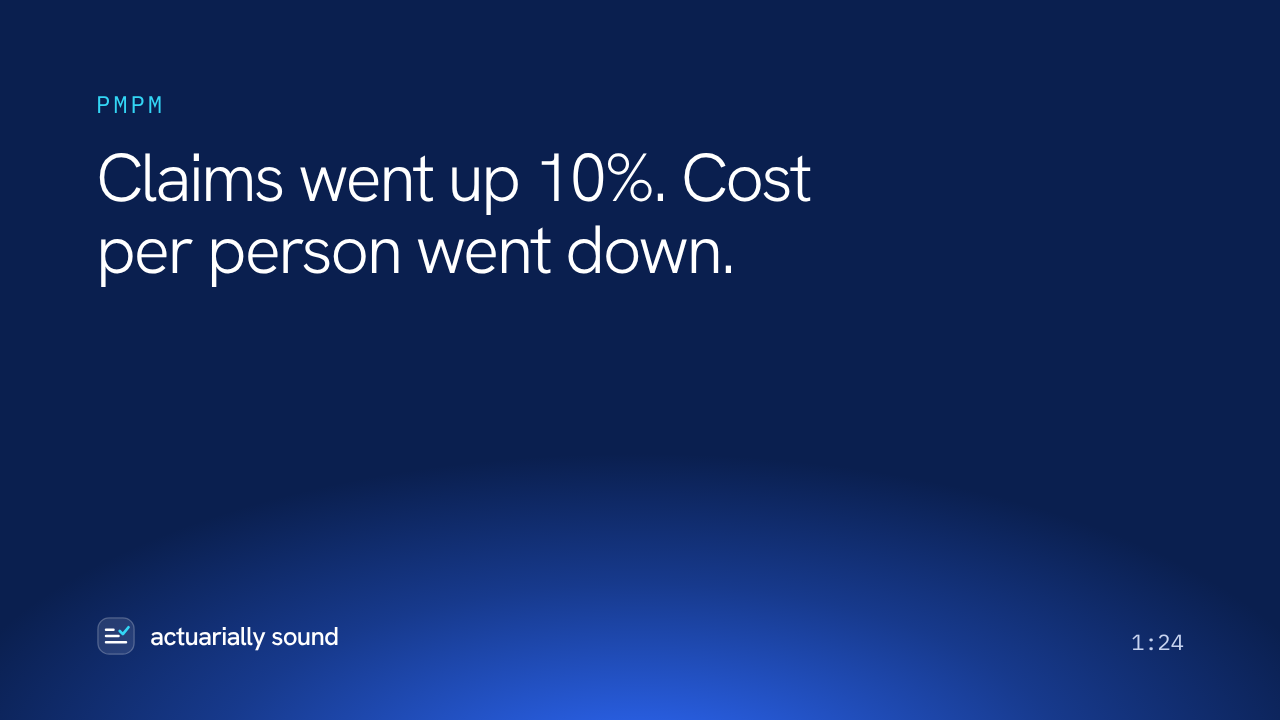
The same group, two years. Claims went up 10%, but the group added 20 members.
| Last year | This year | |
|---|---|---|
| Members (covered all year) | 180 | 200 |
| Member months | 2,160 | 2,400 |
| Total claims | $1,296,000 | $1,425,600 |
| Claims PMPM | $600 | $594 |
Cost per member went down about 1%, even though the claims total went up 10%.
The label changes the number. Last year's group had 100 employees, so the same claims are 1,200 employee months.
| Measure | Divide by | Result |
|---|---|---|
| PMPM (per member per month) | 2,160 member months | $600 |
| PEPM (per employee per month) | 1,200 employee months | $1,080 |
Read the transcript
This group's claims went up ten percent this year. Its cost per person went down. Both are true, and the difference is PMPM.
PMPM means per member per month. Take total claims and divide by member months: everyone covered, counted once for each month they were covered. Someone who joins in July counts six.
Last year, a hundred and eighty members for twelve months made two thousand one hundred sixty member months. One point three million in claims works out to six hundred dollars PMPM. This year, two hundred members and ten percent more claims comes to five ninety-four.
Now watch the label. Divide the same claims by a hundred employees instead and you get PEPM, per employee per month: one thousand eighty dollars. Same claims, almost double the number.
PMPM is also an average. If one member had a two-hundred-fifty-thousand-dollar claim, that alone is about a hundred sixteen dollars of the six hundred.
So ask your carrier three things. Is this PMPM or PEPM? Does it include pharmacy? And what's our PMPM without large claims? Find out more at actuariallysound dot com.
Common misunderstandings
Questions to ask your carrier or broker
- Is this PMPM or PEPM?
- Does it include pharmacy claims?
- What's our PMPM excluding claims above the pooling point?