Why it matters
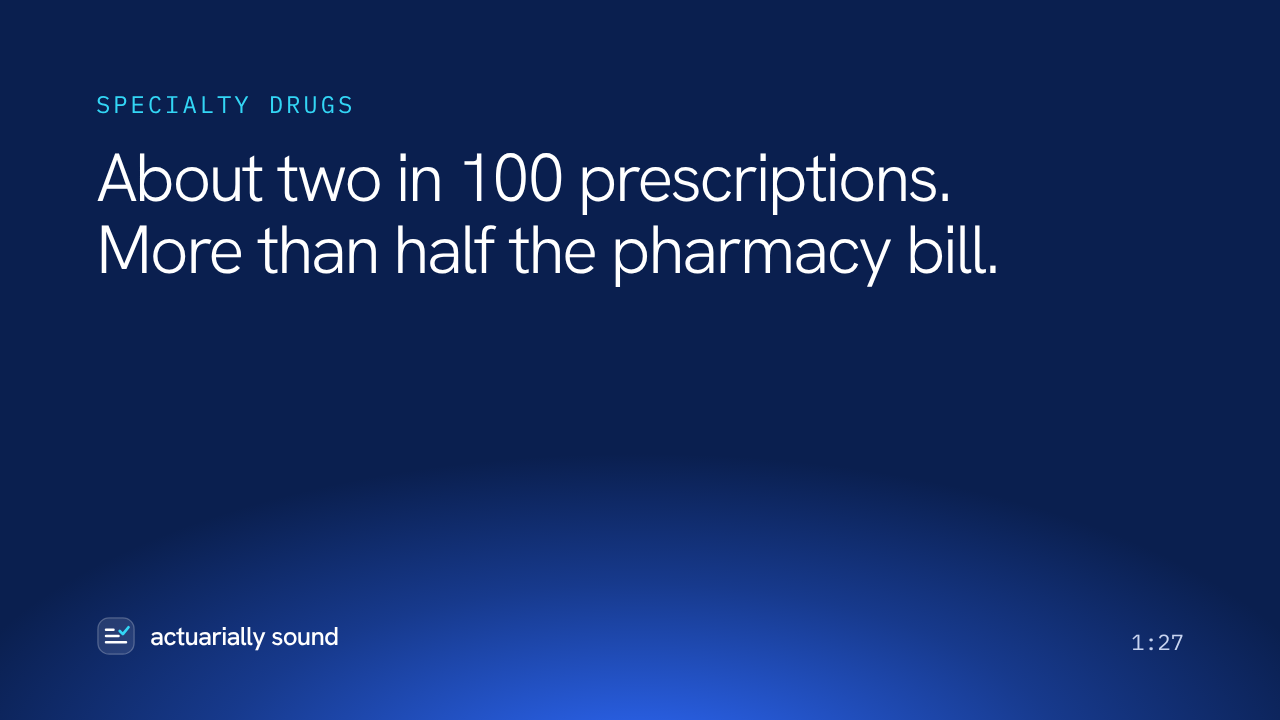
A small number of prescriptions now drives most of what plans spend on drugs. In UnitedHealthcare's employer-plan data (self-funded and fully insured, claims incurred November 2024 through October 2025), specialty drugs were about 2% of pharmacy volume (UnitedHealthcare) and about 55% of total pharmacy benefit spend (UnitedHealthcare 2026 Health Trends Report, May 2026). That's an average across UnitedHealthcare's book of business, and UHC doesn't say whether the 55% is before or after rebates; your plan's mix will differ.
That 55% counts only the pharmacy benefit. Many specialty drugs are given in a clinic, infusion center or hospital and billed under the medical benefit, so a plan's total specialty spend is usually higher than its pharmacy report shows.
More members are using them, too. In Pharmaceutical Strategies Group's book of business, the share of members using at least one specialty drug rose from 4.4% in 2023 to 5.5% in 2025, and PSG projects gross specialty costs per member per year will rise another 32% by 2028 (PSG, July 2026).
What makes a drug "specialty"
There's no single definition. Each PBM and plan keeps its own specialty list, so the same drug can be specialty in one plan and not another. Most specialty drugs share some of these traits:
- They treat complex, chronic or rare conditions, such as rheumatoid arthritis, multiple sclerosis, Crohn's disease and some cancers.
- They're often injected or infused rather than taken as a pill. Many are biologics, made from living cells.
- They need special handling, such as refrigeration, careful shipping or close monitoring of the patient.
- They cost a lot, typically thousands of dollars a month. Some cell and gene therapies cost up to about $4 million per treatment (UnitedHealthcare, May 2026).
Medicare uses a dollar test for its specialty tier: a Part D drug is eligible for the specialty tier when its ingredient cost for a 30-day equivalent supply exceeds $950 in 2026, rising to $1,080 in 2027 (CMS). That rule is for Medicare drug plans, not employer plans, but it gives a sense of the price level.
Worked example: one member, one treatment
All amounts are hypothetical. The drug cost is what the plan pays after rebates and member cost sharing, not a list price or a specific drug, and it's held flat for illustration.
| Measure | Amount |
|---|---|
| Plan-paid drug cost per month | $7,000 |
| Plan-paid cost for one year | $84,000 ($7,000 × 12) |
| Plan size | 250 members |
| Member months in a year | 3,000 (250 × 12) |
| That treatment's claims per member per month | $28 ($84,000 ÷ 3,000) |
One member's treatment adds about $28 to the plan's average claims per member per month. That's a contribution to claims, not an automatic $28 premium increase, and some of it may replace spending on a treatment the member used before.
What makes specialty costs different from most large claims is that they can recur. Many specialty drugs for chronic conditions like rheumatoid arthritis and multiple sclerosis are taken for years, so the cost can come back each year rather than once. Claims studies show the pattern isn't steady: in one multiple sclerosis study, about two-thirds of patients were still on therapy a year after starting (Oleen-Burkey et al., BMC Neurology, 2014), and in one rheumatoid arthritis study of patients already on their second biologic, about half had switched or stopped within a year, often to another specialty drug (Johnston et al., Rheumatology and Therapy, 2015). Prices change too, so the cost won't necessarily repeat at the same level.
The example leaves out stop-loss. On a self-funded plan, whether stop-loss insurance reimburses any of a claim like this depends on the plan's specific deductible and contract terms. At renewal, a known ongoing specialty claim can also lead the stop-loss carrier to set a higher deductible for that member (a "laser").
Read the transcript
In UnitedHealthcare's employer-plan data, about two in every hundred prescriptions are specialty drugs. Together, they cost more than the other ninety-eight combined.
Specialty drugs treat complex or rare conditions, like rheumatoid arthritis, multiple sclerosis, and some cancers. Many are injected or infused, need special handling, and cost thousands of dollars a month.
Here's a hypothetical. One member starts a drug that costs your plan seven thousand dollars a month. That's eighty-four thousand a year, and for a chronic condition, it can come back every year. On a two hundred fifty member plan, that treatment accounts for twenty-eight dollars per member per month in claims.
Some specialty drug costs don't show up on your pharmacy report. Drugs given in a clinic or hospital are often billed under the medical benefit. And where they're given matters. One study of non-cancer infusions found outpatient costs were about forty-two percent higher in hospital outpatient departments than in alternative settings.
Ask your broker: How much of our specialty spend is under the medical benefit? Where are members getting infusions, and at what cost? And how are we planning for specialty drug costs that may recur each year? Find out more at actuariallysound dot com.
Two places it gets billed
Specialty drugs reach members through two benefit channels, and a plan's reports usually show them separately:
- Pharmacy benefit. Drugs the member picks up or has shipped, often self-injected at home, are filled by a pharmacy (usually a specialty pharmacy) and run through the PBM. These show up on your pharmacy report.
- Medical benefit. Drugs a provider gives in a doctor's office, infusion center, the member's home or a hospital outpatient department are often billed by that provider as a medical claim. These usually don't show up on your pharmacy report.
Where an infusion is given matters. A study published by Elevance Health's Public Policy Institute compared non-cancer infusion therapies across sites of care, using matched commercial claims from 2022–23 (52,760 infusions, 18,988 patients). Outpatient costs within one day of an infusion were about 42% higher in hospital outpatient departments than in alternative settings such as infusion centers, physician offices and the home, with similar short-term safety outcomes, such as emergency visits, hospital admissions and adverse events (Cullen et al., Journal of Managed Care & Specialty Pharmacy, 2026).
Read the other way, the alternative settings cost about 30% less (1 − 1 ÷ 1.42), not 42% less. The study covers non-cancer infusions only, and it doesn't guarantee savings for any one member or plan; some members need a hospital setting for clinical reasons.
Who fills them, and the biosimilar shift
Specialty pharmacies are concentrated. In 2025, the three largest specialty pharmacies accounted for two-thirds of prescription revenues from pharmacy-dispensed specialty drugs, and all three are owned by organizations that also own a PBM (Drug Channels Institute, April 2026). That figure excludes drugs billed under the medical benefit. It's one reason PBM contract terms on specialty pricing and pharmacy networks matter.
Biosimilars are changing the mix. A biosimilar is a lower-priced version of a biologic drug from another manufacturer. PSG reports that Humira biosimilars went from 0.3% market share in 2023 to 82.4% in 2025 (PSG, July 2026); PSG's release doesn't say whether that share is measured by claims, units or spend. A switch to a biosimilar doesn't by itself prove savings: the plan's net cost depends on the rebates it was getting on the original drug versus the biosimilar's net price.
Common misunderstandings
Questions to ask your broker
- How much of our specialty spend is under the medical benefit? Ask for specialty spend from both pharmacy and medical claims, side by side, so you see the full total and not just the pharmacy report. If you're fully insured, first ask what claims reporting the carrier will release for a group your size.
- Where are members getting infusions, and at what cost? Ask how infusion claims split across hospital outpatient departments, infusion centers, physician offices and home infusion, and what the plan pays in each. If you're fully insured, ask whether the carrier has a site-of-care program.
- How are we planning for specialty drug costs that may recur each year? Ask how ongoing specialty treatments are reflected in your renewal and budget. If you're self-funded, ask how they affect your stop-loss; if you're fully insured, ask how the carrier's large-claim pooling treats them.