Why it matters
A renewal increase reads like one number, but it's several pieces added together. Medical trend is the only piece you can benchmark from the outside. Everything above it comes from your group's own experience or the carrier's terms, and that's the part worth a conversation before you sign.
How the carrier combines those pieces is covered in Experience Rating. This page is about the offer itself and what to do with it.
What's inside a renewal increase
- Medical trend: rising prices and use of care. The one piece you can compare with published surveys.
- Your own claims: how your group ran, weighted by credibility. Ask for claims and loss ratio by month.
- Large claims: a few high-cost members. Ask what was pooled, and above what amount.
- Enrollment: changes in headcount, ages and family mix. Compare this year's census with last year's.
- Plan changes: deductibles, copays, networks. Ask what each change is worth.
- Fees and margin: what the carrier keeps for administration, taxes, risk and profit, often labeled "retention" on the exhibit (not employee retention). Together these set the carrier's target loss ratio. Ask for these costs in dollars and as a percentage.
Worked example
A group paying $1,500,000 a year receives a +14% renewal. Published surveys put trend at about 8% to 11%.
| Rate | Annual amount | |
|---|---|---|
| Trend, low | 8% | $120,000 |
| Trend, high | 11% | $165,000 |
| Proposed renewal | 14% | $210,000 |
| Above the top of the trend range | 3 points | $45,000 |
The timing catch
For a January 1 plan year, the offer typically lands in October or November. The claims behind it often run through the middle of the year, because carriers wait for recent claims to finish coming in (see IBNR). A rough spring can show up in your renewal even if the fall was quiet, and recent improvements may not count yet.
Small groups (usually under 50 employees, under 100 in a few states) are different: their renewals mostly follow the carrier's filed rate increase, age changes and plan changes rather than the group's own claims.
Read the transcript
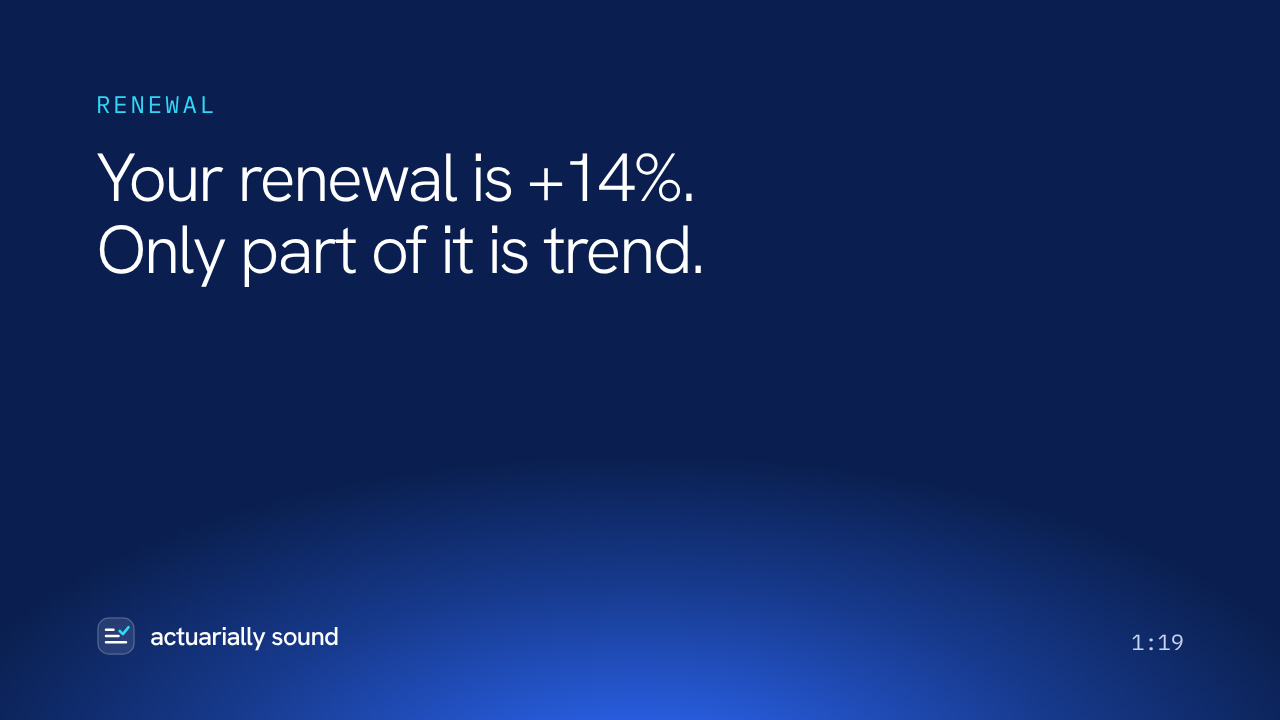
This renewal is up fourteen percent. That isn't one number. It's several pieces stacked together, and only one of them is trend.
A renewal is your carrier's price for the next plan year. It usually arrives sixty to ninety days before the plan year starts. But the claims it's built on often end five or six months before that.
Start with trend. Medical costs rise every year, and surveys put next year's trend at about eight to eleven percent. On a one-point-five-million-dollar premium, that's a hundred twenty to a hundred sixty-five thousand.
Fourteen percent is two hundred ten thousand. So even at the top of the trend range, at least forty-five thousand is something else: your own claims, a few large ones, who's enrolled, plan changes, or the carrier's fees.
That part is worth asking about. A first offer is often a starting point, not the final price. Our free Renewal Checker shows how much of yours is trend.
So ask your broker three things. What's driving this beyond trend? What claims period is it based on? And what are our options? Find out more at actuariallysound dot com.
Common misunderstandings
Questions to ask your broker
- What's driving this beyond trend?
- What claims period is it based on?
- What are our options: plan changes, other carriers, or a different funding approach?
- Can we see the renewal exhibit, including pooling and the carrier's fees?